



Most LinkedIn Ads budget guides are running on two-year-old data. LinkedIn CPMs jumped 145% in the past 12 months — from $38 in October 2024 to $93 in October 2025
— and the “recommended budget” figures most guides cite haven’t caught up.
Two kinds of marketers get burned.
The first underspends, runs $500–$1,000/month, sees thin results, and concludes LinkedIn doesn’t work.
The second follows the instinct to “just increase budget” without a formula, and watches CPL balloon as the audience saturates.
This guide breaks down the six-step formula we use to calculate accurate LinkedIn Ads budgets for our clients. It takes in ICP audience sizes, CPMs, and penetration targets to see real ROI for LinkedIn Ads spend.
And then, you can steal it to use for your own account!
Let’s get started.
TL;DR: LinkedIn CPMs peaked at over $100 last year, according to KlientBoost LinkedIn CPM data. Yet 48% of businesses still spend under $500/month — a budget that reaches fewer than 7% of a typical 10,000-person ICP. Use the Reach Ratio™: (Audience × Reach % × Frequency ÷ 1,000) × CPM = your monthly budget.
Why LinkedIn Ads Cost More Than Every Other Platform (And Why That’s Fine)
LinkedIn CPMs average $33–$65 for typical B2B targeting — roughly 3–6× higher than Meta’s $5–$15 range (Dreamdata 2025). That premium you’re buying is verified job titles, seniority levels, and company-size data that other channels like Meta simply don’t offer.
According to Dreamdata’s 2025 Benchmarks Report which analyzed 23 million sessions and 220,000+ B2B customer journeys, LinkedIn Ads deliver 113% ROAS which is the highest of any major ad network tested.
But the cost-per-company-influenced tells a clearer story than CPC or CPM alone.
On LinkedIn, it averages €154. The same metric on Google Search runs 25% higher and on Meta, it’s 70% higher (Dreamdata 2025). If your goal is influencing the right companies and not just generate cheap clicks, LinkedIn’s premium is justified.
Just look what happened with spend last year.
B2B marketers voted with their budgets and LinkedIn’s share of total B2B ad spend climbed from 31% in H1 2024 to 39% by year-end. It’s now the single largest individual channel allocation in Dreamdata’s benchmark cohort, but it isn’t getting cheaper.
What’s the Minimum LinkedIn Ads Budget? (And Why LinkedIn’s Own Number Is Wrong)
LinkedIn’s official minimum budget is $10/day or $100 over the lifetime of a campaign, and the platform recommends $25/day for best results.
At today’s $93 CPM and a frequency target of 8 impressions per month per person, LinkedIn’s recommended $750/month reaches roughly 8% of a 10k-person ICP. That’s far too thin to generate statistically meaningful optimization data or measurable brand recall.
The practical minimum for a test campaign that produces usable data: $30–$50/day ($900–$1,500/month). If its below that, your daily budget will exhaust before LinkedIn’s delivery algorithm can optimize, and frequency impressions drop below the threshold for measurable B2B brand recall.
If you’re under $1,000/month, shift to retargeting-only. The LinkedIn Insight Tag lets you retarget all website visitors — not just those who arrived through LinkedIn. Warm audiences convert at 3–5× the rate of cold, and $1,500/month can reach a 2,000-person retargeting pool with 10–12 impressions per month at current CPMs.
How to Calculate Your LinkedIn Ads Budget
The right LinkedIn Ads budget isn’t a fixed number, it’s based on hitting your comprehensive reach.
Comprehensive reach: reaching a significant portion of an audience with paid media activity
You need a competitive strategy and a memorable brand to generate demand. Then, go after comprehensive reach to maximize the highest mental availability (memory recall) from your paid ad demand gen efforts.
When more people know WHO you are, WHAT you do, and HOW you solve their problems (jobs theory), more people will naturally want to get in touch WHEN they need what you sell.
Comprehensive reach looks different for different B2Bs.
Aim for 80% audience reach—minimum.
This will maximize your ability to convert the 5% of buyers who are in-market right now and simultaneously build future revenue potential in the giant 95% pool of buyers who aren’t.
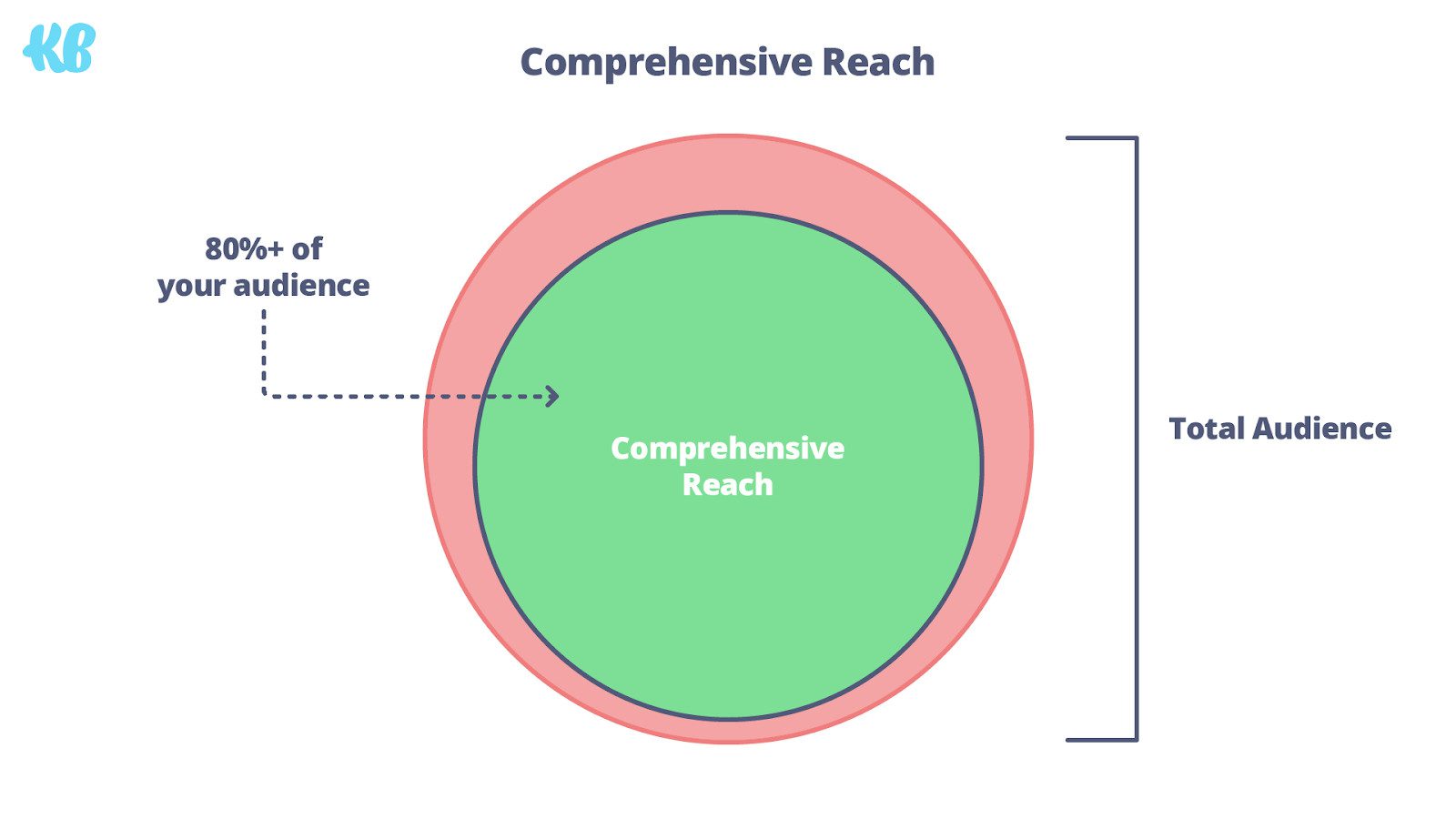
Once you understand this, you can layer in four variables: ICP audience size, target reach percentage, desired impression frequency, and current CPM.
I recommend using KlientBoost’s Reach Ratio™ formula to calculate this.
KlientBoost has applied this framework across B2B clients in SaaS, professional services, and financial services. In SaaS, CPMs typically run $100–$200 depending on audience specificity, which means the same 10k ICP-audience can cost up to 2× more to reach than the US B2B average of $93.
Here’s how to work through it, step by step.
Step 1: Define your ICP audience size
Open LinkedIn Campaign Manager and build your audience using job title, seniority, company size, and industry filters.
The audience estimator shows you the matching member count. This is your Audience variable.
Most B2B companies find their real LinkedIn-accessible ICP is 5,000–50,000 people — smaller companies often overestimate, and larger companies often underestimate how segmented their targeting gets.
Step 2: Set your target reach percentage
For brand awareness: 30–50% is sufficient.
For demand generation, where you need visibility across the full buying committee, target 70–80%.
Running above 80% typically produces diminishing returns because auction CPMs spike as the remaining audience shrinks.
Step 3: Set your frequency goal
Aim for 6–8 impressions per month per person for awareness-stage campaigns and 10–12 for active demand creation, where your brand needs to be recalled during a live buying cycle.
Don’t aim for anything less, otherwise your campaigns won’t make a dent with your target audience.
Step 4: Pull your current CPM
Check your Campaign Manager performance data for recent campaigns.
Use $93 as a US B2B baseline if you’re launching fresh. SaaS audiences targeting VP+ or Director+ titles run $120–$200. Broader job function targeting (Marketing, Finance, Engineering) runs lower.
Step 5: Run the formula
Once you have all the data, you can run the Reach Ratio calculation: (Audience × Reach % × Frequency ÷ 1,000) × CPM = monthly budget
For a 10,000-person ICP at 80% reach, 8 impressions/month, and $93 CPM:
(10,000 × 0.80 × 8 ÷ 1,000) × $93 = $5,952/month
LinkedIn’s recommended $25/day ($750/month) reaches the same audience at 10% penetration. That’s 1,000 people — not a B2B campaign, it’s a post-boost.
Step 6: Add 20–25% for retargeting
Layer a retargeting campaign — targeting website visitors, lead form openers, and video viewers — on top of your cold outreach.
Allocate 20–25% of your primary campaign spend to this layer. This is where the majority of direct conversions come from, at a fraction of the CPM of cold audiences.
LinkedIn Ads Budget by Business Stage
Budget requirements are driven less by company size and more by ICP size, sales cycle length, and funnel objective.
Startups entering LinkedIn typically begin at $1,500–$3,000/month; growing B2B businesses run $5,000–$15,000/month; enterprise programs start at $20,000/month and scale from there.

The $5,000/month line is a real threshold, not just a round number.
Below it, a cold campaign targeting a 10,000+ person ICP either exhausts its daily budget before the afternoon buying window or runs at too low a frequency to build meaningful recall. The budget gets spent, but the impression pattern doesn’t stick.
When to Increase Your Budget (And When It Will Backfire)
Increasing budget only produces better results when three conditions are true: your ICP still has reach headroom (you haven’t saturated 80%+), your creative is working (CTR consistently above 0.55%), and your conversion infrastructure can handle the volume. Miss any one of these, and more budget accelerates a problem you haven’t fixed yet.
Timing matters more than most B2B marketers account for. According to Dreamdata’s 2025 data, Q2 generates 30% of annual LinkedIn Ads MQLs using only 18% of annual budget — the most efficient quarter by a significant margin. Q4 inverts that: 31% of budget produces just 20% of MQLs, as buyer decision-making slows and CPMs climb from competitive pressure.
Four signals that mean you should hold budget, not add it:
- Daily budget exhausts before 2pm. Your ICP is too small for efficient pacing. Expand your audience before increasing spend.
- Frequency above 15 with flat or declining CTR. Creative fatigue. Refresh before spending more.
- CPL rising quarter-over-quarter with stable volume. Audience saturation. New segments needed.
- You’re in Q4 without strong intent signals in the pipeline. Redirect to retargeting; hold cold spend for Q1–Q2.
Recalibrate budget every 90 days. CPMs fluctuate with competitive pressure, and your ICP shifts as your TAM strategy evolves.
How Long Until You See ROI? Planning Your Budget Horizon
According to Dreamdata’s 2025 report — tracking 220,000+ completed B2B customer journeys — the average time from a first LinkedIn Ad impression to closed revenue is 320 days. That’s not a flaw in the platform. It reflects how B2B buying works. The 95:5 rule applies: only 5% of your ICP is actively in-market at any moment. LinkedIn’s job is to stay visible to the other 95% until they enter a buying cycle.
That timeline reshapes how you measure budget performance.
If your average sales cycle is six months, your LinkedIn Ads measurement window should be twelve months — not 30 days. Cold campaigns at $5,000/month typically reach break-even ROI around months 3–4. Before that inflection, you’re building the pipeline that converts later. Pausing early means paying the full awareness cost again from scratch when you restart.
Attribution models undercount LinkedIn’s contribution systematically. Last-touch models credit the form fill or the demo request. LinkedIn influenced 36% of SQLs and 35% of closed-won deals in Dreamdata’s cohort — but most of those touchpoints preceded the “attributed” channel by months. Your LinkedIn Ads budget is doing work that your CRM isn’t reporting.
One technical change that improves both measurement and performance: LinkedIn’s Conversions API (CAPI). Advertisers who integrate CAPI and send actual revenue data — not just first-conversion signals — back to Campaign Manager see 20% lower CPA and 31% higher attributed conversions versus pixel-only tracking (Dreamdata/LinkedIn 2025). It’s the highest-leverage technical change you can make without touching the ads themselves.
Frequently Asked Questions
What is the minimum budget for LinkedIn Ads?
LinkedIn’s official minimum is $10/day or $100 lifetime. The practical minimum for a campaign that generates usable data is $30–$50/day ($900–$1,500/month). Below that threshold, daily budgets exhaust before LinkedIn’s delivery algorithm can optimize, and most accounts see fewer than 2 impressions per month per person — below the measurable recall threshold for B2B brand recognition.
How much do LinkedIn Ads cost per month for small businesses?
Small businesses should allocate $1,500–$3,000/month on LinkedIn. At this budget level, the highest-ROI approach is retargeting-only via the LinkedIn Insight Tag — targeting website visitors who already know your brand. Warm audiences convert at 3–5× the rate of cold audiences, and $1,500/month can reach a 2,000-person retargeting pool with 10–12 impressions per month at current CPMs.
Why are LinkedIn Ads more expensive than Facebook or Google?
LinkedIn CPMs average 3-6x higher prices for B2B targeting versus Meta and Google. The difference is LinkedIn auctions are smaller, more targeted, and contain fewer available impression slots per B2B niche. However, the ROI justifies the premium. According to Dreamdata, LinkedIn delivers 113% ROAS versus Meta’s 29% ROAS, influences 36% of SQLs, and costs 25% less per company influenced than Google Search.
How do I know if my LinkedIn Ads budget is too low?
Four clear indicators: your daily budget exhausts before noon, your ICP audience reach is below 30% after 90 days, you have fewer than 50 monthly conversions (which is too little data for bid optimization), and impression frequency is <5/month. Use our Reach Ratio™ formula to calculate if your current monthly spend is enough to meet your target.
Is LinkedIn Ads worth it for B2B companies?
For B2B companies targeting decision-makers on LinkedIn, yes — with sufficient budget.
LinkedIn delivers 113% ROAS and offers cost-per-company-influenced that’s 25% lower than Google Search. However, LinkedIn requires a 6–12 month measurement window and at least $3,000–$5,000/month to generate the data volume needed for effective optimization. Under-budgeted LinkedIn campaigns are the primary driver of “LinkedIn doesn’t work” narratives.
Conclusion
LinkedIn CPMs have risen faster than most budgets have adapted. The framework for calculating the right spend hasn’t changed — it’s always been audience × reach × frequency ÷ CPM — but at $93 CPM versus $38 eighteen months ago, every budget set on old assumptions is now underperforming by design.
Run the Reach Ratio™. Start with your ICP size in Campaign Manager. Target 70–80% reach, 8 impressions per month, and today’s CPM. Add 20–25% for retargeting. Recalibrate every 90 days as CPMs and audience composition shift.
Not sure how to apply the Reach Ratio™ to your specific ICP? Work with KlientBoost’s LinkedIn Ads team →