



TL;DR: Marketers have one collective downfall: most of us are really bad at showing the impact of our work on revenue.
This session will teach you to fix it. Patrick and Adam went deep into the weeds on how to tie influenced attribution to customer journeys to build a narrative that marketing drives pipeline.
Subscribe to our weekly newsletter for tips so good that we might put ourselves out of business.
Top Takeaways
- We can't trust click-based attribution anymore. 30-50% of conversions vanish due to cookie rejection and 75-95% iOS tracking opt-out rates leave most B2B companies operating in a data black hole
- The “marketing funnel” doesn't match real buyer journeys. An MQL today doesn't equal revenue tomorrow. If you model your marketing story to execs around this, it can destroy forecasting and executive confidence in your campaigns
- Influenced attribution shows how your buyers REALLY buy. Tracking impression-level touchpoints before a deal enters the CRM is the new way marketers can prove channels like LinkedIn ads warmed accounts months, even before last-click channels try to steal credit for the conversion
- Lead with insights your execs care about, not platform metrics. Starting exec reports with influenced attribution triggers skepticism. Open with correlation modeling or MMM channel mix audits to establish credibility for your work first.
- Tell a compelling story with your buyer’s journeys. Show executives the specific path of high-ACV deals that appeared as "direct traffic" in HubSpot but actually received 4+ months of LinkedIn ad impressions before converting.
Traditional Attribution Won't Work In 2026
As marketers, we know the problem with this discussion isn’t that marketing doesn't work, it's that we don't have the tools and data to prove it works.
There are three huge problems with how most marketers report wins:
- What used to be simple online tracking is now fragmented across platforms that block cookies and reject pixels. Without offline conversion tracking or server-side implementations, most companies can't see the full buyer journey
- Linear funnels paraded by execs on decks for years have set marketers up for unrealistic expectations. Executives expect 100 MQLs to produce 50 SQLs at a predictable conversion rate, but buyers don't move that cleanly through stages anymore. The math breaks down, forecasts miss targets, and marketing loses credibility
- Finally (and this is one we can fix), marketers really, really suck at presenting results. We usually walk into meetings on the defensive—already apologizing for gaps in attribution—and it sets a weak foundation for the rest of the discussion
"I've had so many conversations with CEOs where they don't really understand the point of marketing. They see it as a lead gen channel for sales rather than anything else."
— Adam Holmgren
To prove marketing works, marketers must flip the script and come prepared with a multi-layered data story that positions marketing as a revenue driver for the business.
Influenced Attribution Can Fill In Your Proof Gaps
Influenced attribution isn’t a replacement for traditional attribution methods like last-click. What it does is zooms out and measures what have traditionally been called “vanity” metrics like impressions and engagement, and then ties them back to buyer journeys.
The methodology ignores where deals are sourced in the CRM and looks at what touchpoints occurred before a deal was even created.
Adam explained in the session that the concept of Fibbler, which does exactly this, originated from manually stitching together LinkedIn ad data with HubSpot deals to prove the value of his marketing campaigns.
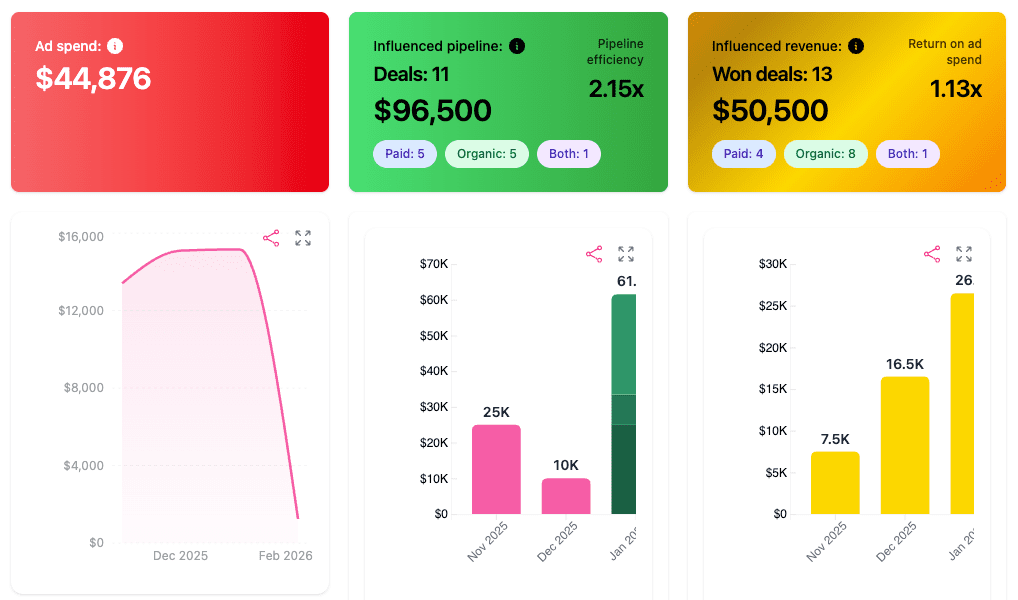
Here's an example of how it works in practice:
- A deal closes in January 2026 with "direct traffic" as the source, and HubSpot shows nothing
- But influenced attribution reveals the account received LinkedIn ad impressions starting in September, ramping up through retargeting in November and December before finally converting.
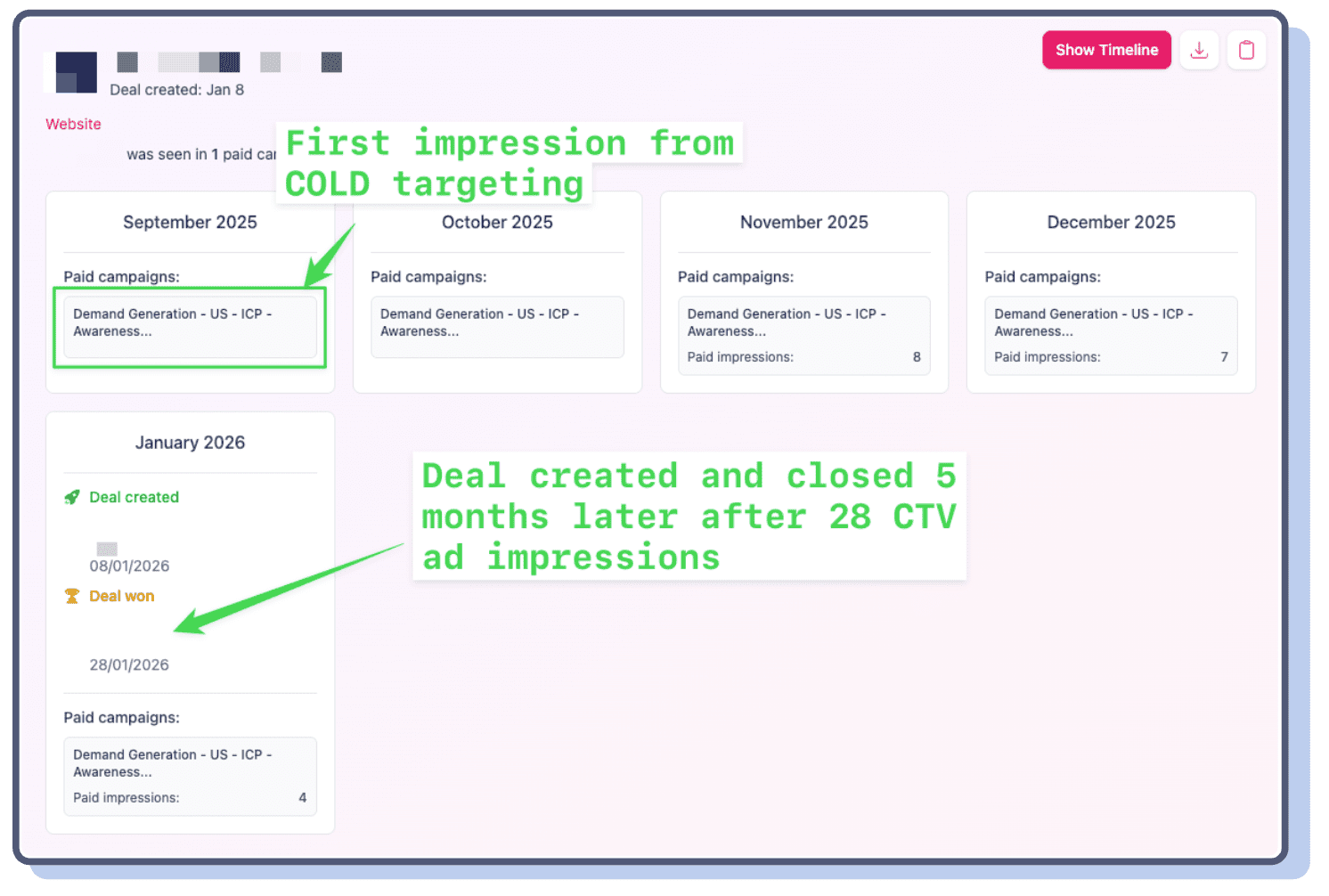
That's the real story. And measuring influenced attribution can tie engaged accounts to future pipeline and current deals.
This reframes the value of “brand” that non-marketers usually dismiss as a fluffy waste of money. Instead of defending awareness campaigns, you can use influenced attribution data to present engagement metrics as leading indicators of deals that will close 3-6 months later.
"Impressions are the broadest picture we can get. You can argue if it was qualitative or not, but with cookie consent, it's what we have."
— Adam Holmgren
It’s important to remember that influenced attribution is not a fix-all metric.
It shows trends and fills gaps in your attribution data, but it must work alongside other data sources to build the complete picture.
How To Tell Your Marketing Story To Execs
The structure of your exec report and how you create a narrative matters as much as the data itself. Here’s some advice from Patrick on how to do it:
1. Lead with business data insights first
Open with high-level correlation modeling or MMM channel mix audits. Don’t start off with influenced attribution or in-platform metrics, as it can trigger doubt with boards.
The better road is to build credibility and tie campaigns to business outcomes before diving into attribution details.
2. Validate with multiple data layers
After presenting the business case, bring in platform data and influenced attribution to strengthen the argument.
Then add the knockout punch: pull buyer journey examples from your highest-ACV deals. Show executives exactly how accounts that looked like "organic search" or "direct traffic" in HubSpot actually engaged with marketing for months before converting.
3. Connect insights to action plans
Don't just present data. Outline what you'll do differently based on what you've learned. Align those actions directly to business goals, because the data should show these engaged accounts are future pipeline.
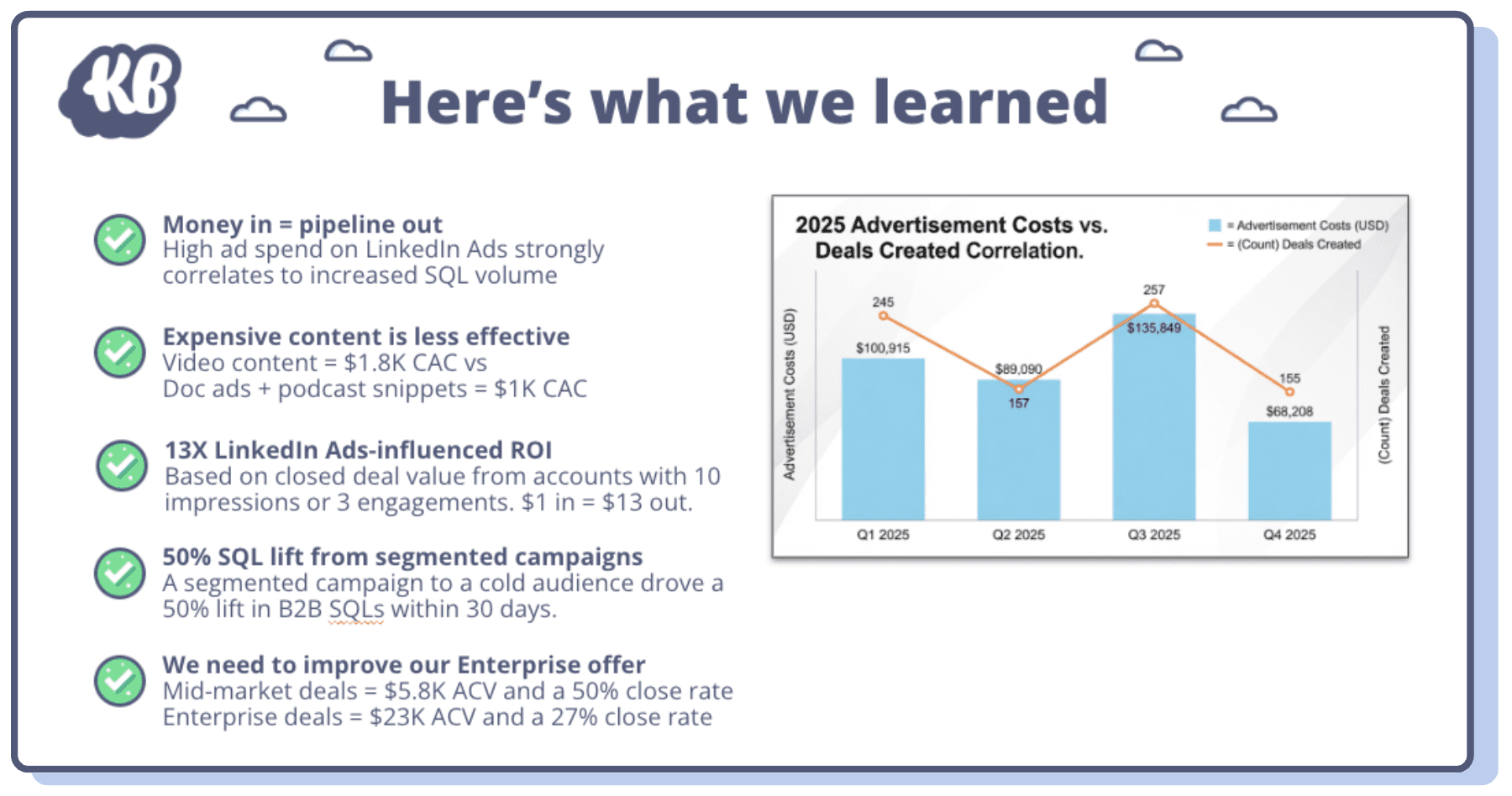
Marketing leaders report that executives immediately latch onto this phrase because it translates awareness metrics into revenue language they understand.
4. Include qualitative signals alongside quantitative proof
Even simple tactics like asking "how did you hear about us?" in onboarding calls provide qualitative validation to strengthen marketing’s overall narrative. The more data points you bring together, the harder it becomes for folks who are skeptical of marketing to dismiss your impact.
"It's important to paint a story around all of this because that's how you get executives to understand."
— Adam Holmgren
Win More Pipeline with LinkedIn Ads Campaigns + Influenced Attribution
This is exactly what we do at KlientBoost. We help B2B SaaS marketing teams move from defending budget to proving pipeline impact, so you can:
- Build influenced attribution reports that reveal marketing's hidden contribution
- Correlate ad spend to closed revenue with executive-ready narratives
- Map complete buyer journeys showing touchpoints your CRM misses
- Scale campaigns with confidence using multi-layer attribution frameworks
If you want to see what this looks like, book a call with Patrick to snag a spot for our Q1 B2B Pipeline Sprints (which include Fibbler access). It includes a LinkedIn Ads account audit and setup as well as Fibbler tracking implementation. At the end of the sprint, we will then build an executive report to finally show this channel's impact on pipeline.
We also recommend grabbing the 60-day free trial over at Fibbler, an official partner of KlientBoost!